
Electronic component obsolescence: what to do when a chip is no longer made?
As soon as the manufacturer's end-of-life notice arrives, assess your options: a last-time buy to cover the remaining production, a compatible replacement part, or a new board revision. The choice depends on the product's remaining lifetime. In the last two cases, the firmware must be adapted and the product tested again.
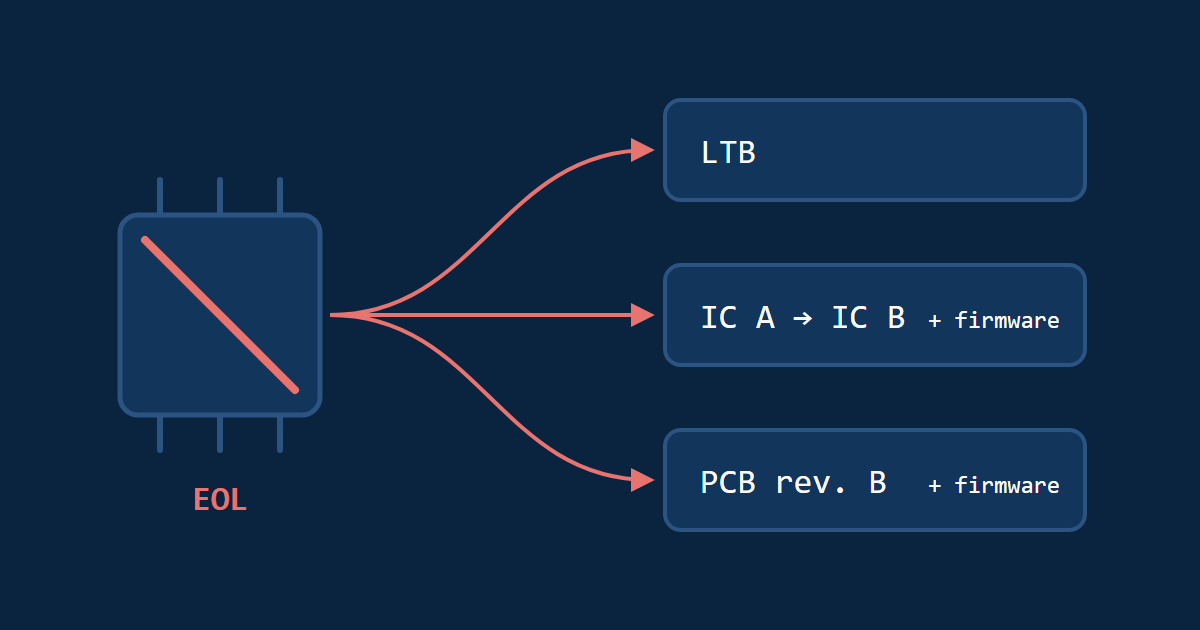
As soon as the manufacturer's end-of-life notice arrives, assess your options: a last-time buy to cover the remaining production, a compatible replacement part, or a new board revision. The choice depends on the product's remaining lifetime. In the last two cases, the firmware must be adapted and the product tested again.
How do you know a component is going away?
Manufacturers publish change notices (PCN, Product Change Notification) and end-of-life notices (EOL). An end-of-life notice usually sets a last order date (LTB, Last Time Buy). Subscribe to these notices for the critical parts of your bill of materials, and watch their status with your distributors.
Should you make a last-time buy?
It is the fastest solution when the product itself is nearing the end of its life: you buy enough to cover the remaining production and after-sales service. It ties up stock and requires proper storage conditions. It does not suit a product that must still be sold for a long time.
Can the component be replaced without redesigning the board?
Sometimes. A pin-compatible part, from the same family or another manufacturer, avoids a new board. Its electrical characteristics and behaviour must still be checked: a "compatible" part is not always identical. The firmware often has to be adapted, for example for a new microcontroller revision or a sensor with different registers.
When is a new board revision needed?
When no direct replacement exists, or when several components age at the same time. It is also a chance to choose more recent parts and fix the board's known defects. The firmware is then ported to the new hardware.
What should be done on the firmware side?
- Isolate hardware access in an abstraction layer: the rest of the code does not change when a component changes.
- Keep a reproducible build of the version in the field, to compare before and after.
- Replay the tests on both the old and the new board.
Must compliance tests be redone?
It depends on the change. Replacing a radio module or part of the board may call into question the assessment made under the RED directive (2014/53/EU). To find out which tests to redo in your case, contact your test laboratory or a regulatory adviser.
How we can help
Picodev looks for replacement parts, assesses the impact on the board and the firmware, then adapts and tests the software. For a new board, we work with SGAME as part of the IoTou® offer.
Related service: Maintenance and takeover